The European Erasmus+ project EcoHarmony, coordinated by IQS-URL and led by Dr Gilda Hernández-Maskivker, aims to transform tourism education through sustainability, innovation and international collaboration. The consortium brings together seven organisations from six European countries, including Fundació Sieneva.
Since its launch in 2025, the project has developed an interdisciplinary curriculum covering regenerative tourism, digital transition, circular economy, responsible management and inclusive tourism.
One of its main outcomes is EcoLearn, a digital platform offering ten specialised micro-credentials through short, flexible online training for students, educators and tourism professionals. Credentials will be issued by IQS-URL upon completion.
Co-funded by the European Union, EcoHarmony connects research with industry needs, helping build a more resilient, competitive and sustainable tourism sector.
A new article published in the Journal of Sustainable Tourism provides valuable insights into themes that closely connect with the objectives of the EcoHarmony project, particularly regenerative tourism, inclusion, community engagement and sustainable tourism development.
The article, “Relational–regenerative leadership among women entrepreneurs in food tourism,” authored by Alicia Orea-Giner, Daniela Freund and Itziar Ramírez-García, examines how women entrepreneurs in Spanish food tourism perform and negotiate leadership through relational, regenerative and embodied practices.
Based on fieldwork with five women-led initiatives in Catalonia and 21 semi-structured interviews across Spain, the research identifies leadership practices centred on care, collaboration, situated ethics, regenerative entrepreneurship and collective decision-making. At the same time, it highlights the structural conditions that can affect women’s recognition, legitimacy and access to resources.
Connecting research and the EcoHarmony mission
The publication resonates strongly with the EcoHarmony approach to building knowledge and competencies for a more sustainable and regenerative tourism sector.
Its findings reinforce the importance of looking beyond traditional models of tourism development and considering how tourism can contribute to stronger communities, environmental regeneration, ethical business practices, social inclusion and locally rooted development.
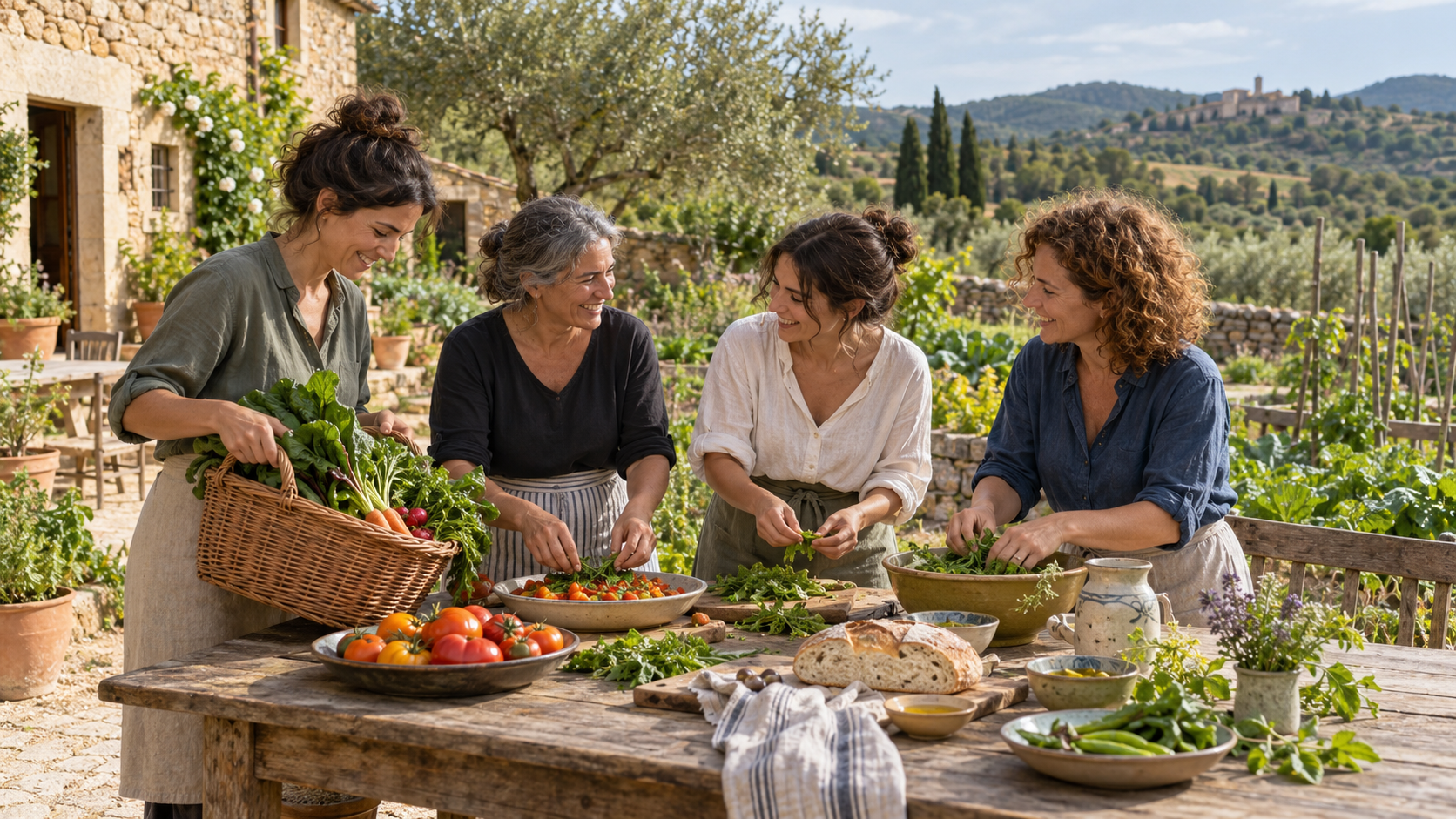
The study conceptualises regenerative approaches as going beyond simply reducing negative impacts. Instead, they seek to strengthen communities and ecosystems through practices such as local and seasonal production, circular and low-waste systems, and the revitalisation of traditional culinary knowledge.
These ideas complement several areas addressed through EcoHarmony’s learning programme, including sustainable and regenerative tourism, ethics and social values, circular and regenerative tourism, local development and community engagement, and strategic approaches to sustainable tourism.
One of the article’s central contributions is a relational–regenerative leadership framework integrating relational care, regenerative ethics and collaborative governance. The framework illustrates how sustainable transformation can emerge through relationships between entrepreneurs, employees, suppliers, customers, communities and other tourism stakeholders.
The publication therefore provides another valuable research perspective supporting EcoHarmony’s broader ambition: equipping learners and tourism stakeholders with the
knowledge and perspectives needed to contribute to tourism systems that are not only more sustainable, but also more regenerative, inclusive, collaborative and community centred.
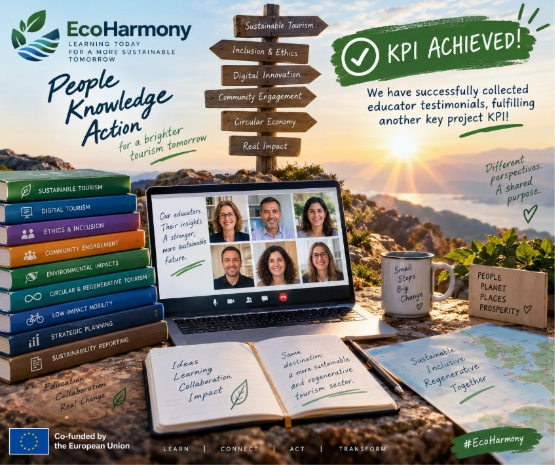
The EcoHarmony Project has reached another important project milestone with the successful collection of testimonials from educators involved in the development of the EcoLearn micro-credential courses. This achievement contributes directly to the fulfilment of a key project Key Performance Indicator (KPI) and provides valuable qualitative evidence of the experiences and perspectives of the educators behind the learning programme.
Teacher 1: “Helping future tourism professionals move from simply understanding sustainability to thinking about how they can contribute to real change.”
Teacher 2: “Sustainable tourism cannot exist without meaningful community participation, local ownership, and shared decision-making.”
Teacher 3: “Technology can be used to create more sustainable, inclusive, and regenerative tourism experiences.”
Teacher 4: “Moving beyond reducing negative impacts towards actively creating environmental and social value.”
The testimonials capture reflections from educators responsible for developing courses across the different dimensions of sustainable and regenerative tourism. These include sustainable and regenerative tourism fundamentals, environmental impacts,
circular and regenerative tourism, smart and digital tourism, ethics and inclusion, local development and community engagement, low-impact mobility, strategic planning and economic impacts, and sustainability assessment and reporting.
Across the testimonials, educators highlighted the importance of transforming complex sustainability concepts into accessible, practical and professionally relevant learning experiences. Case studies, reflective activities, practical exercises, quizzes, videos and real-world examples were incorporated throughout the courses to help learners connect theoretical knowledge with challenges encountered in tourism destinations and organisations.
Educators also identified the flexibility of the EcoLearn online learning environment as an important strength. The asynchronous format enables learners from different locations and backgrounds to progress at their own pace, revisit challenging concepts and engage with the learning materials according to their individual schedules.
The testimonials also provide valuable insights for the future development of the programme. A recurring recommendation was to further strengthen opportunities for interaction and collaborative learning through discussion forums, simulations, peer feedback, scenario-based activities, facilitated sessions and additional real-world applications.
Importantly, participation in EcoHarmony also supported the professional development of the educators themselves. Contributors highlighted learning related to digital course design, assessment and evaluation, learner-centred education, asynchronous teaching and the European micro-credential approach.
The successful collection of these testimonials therefore represents more than the completion of a project KPI. It documents the knowledge, collaboration and professional learning generated through EcoHarmony and provides evidence that the project is contributing to the development of innovative approaches to sustainability-focused tourism education.
This milestone reflects the collective commitment of the EcoHarmony consortium and its educators to creating accessible, relevant and forward-looking learning opportunities that can help prepare tourism professionals to contribute to a more sustainable, inclusive and regenerative tourism sector.
We sincerely thank all participating educators and project partners for sharing their experiences and for their continued contribution to the EcoHarmony Project.
The EcoHarmony Project, co-funded by the European Union through the Erasmus+ Programme, is proud to announce the launch of Eco Learn—an innovative online micro-credentials platform designed to equip learners with the knowledge and skills needed to support the transition towards a more sustainable and regenerative tourism sector.
Eco Learn has been developed to meet the growing demand for flexible, high-quality learning opportunities that prepare students, educators, tourism professionals, and lifelong learners for the future of tourism.
Learn at Your Own Pace
The platform offers 10 specialised modules, each focusing on a key area of sustainable tourism. Learners have complete flexibility to choose the topics most relevant to their interests or complete the full programme.
The Eco Learn Modules
Module 1: Assessment and Sustainability Reporting
Module 2: Fundamentals of Sustainable and Regenerative Tourism
Module 3: Smart and Digital Tourism
Module 4: Ethics, Inclusion and Social Values in Tourism
Module 5: Environmental Impact of Tourism
Module 6: Circular and Regenerative Tourism
Module 7: Strategic Planning and Economic Impacts of Tourism
Module 8: Marketing and Communication in Sustainable Tourism
Module 9: Local Development and Community Engagement
Module 10: Mobility and Low-Impact Tourism
Why Join Eco Learn?
Participants can benefit from:
Complete flexibility—study one module or complete all ten.
A separate official micro-credential for each completed module.
Practical, industry-relevant knowledge developed by an international consortium of higher education institutions and experts.
100% free online access.
Earn an Official University Micro-Credential
Upon successful completion of each module, learners receive an official micro-credential certificate issued by Universitat Ramon Llull, one of Spain’s leading universities.
These certificates recognise newly acquired competencies and demonstrate a commitment to sustainable and regenerative tourism practices.
Join the Movement Towards Sustainable Tourism
Eco Learn is more than an online learning platform—it is an opportunity to become part of a growing European community committed to creating a more responsible, inclusive, and regenerative tourism sector.
Whether you are a student, educator, tourism professional, policymaker, or simply passionate about sustainability, Eco Learn provides practical knowledge that can be applied immediately in both academic and professional settings.
Start your learning journey today.Access the platform here to register and Login:Login | EcoHarmony
The EcoHarmony Erasmus+ project team is proud to announce its contribution to an important academic publication advancing social responsibility and sustainability in tourism and hospitality education. A chapter authored by our project partners, titled “Reimagining Tourism Education for a Sustainable and Regenerative Future,” has been published in the book Social Responsibility in Hospitality and Tourism: Bridging Education and Practice.
This volume focuses on how social responsibility in hospitality and tourism can move beyond theory into real-world professional practice. The EcoHarmony chapter specifically addresses how sustainable and regenerative tourism education can be embedded within European higher education through a research-informed and practice-oriented framework.
Drawing on focus groups conducted in six European countries and a large-scale cross-European survey, the chapter analyses the current state of tourism education and highlights a key challenge: while sustainability is present in many programmes, its integration remains fragmented rather than holistic
In response, the chapter proposes concrete strategies including interdisciplinary curriculum design, micro-credentials, experiential learning, and the meaningful integration of digital technologies such as AI and VR
EcoHarmony aims not only to support sustainable tourism education, but to promote a regenerative model that actively contributes to social and ecological well-being. This publication strengthens the academic impact of the project and provides higher education institutions across Europe with a practical roadmap for systemic transformation.
More information about the book is available on the Routledge website [HERE]
The global travel and tourism sector continues to transform, embracing sustainability not just as a buzzword but as a strategic pillar for long-term resilience and community wellbeing. From policy initiatives to innovative models of travel that go beyond minimizing harm, recent developments show a clear shift toward regenerative and impact-positive practices in tourism.
Tourism Policy Shifts Toward Sustainability
In 2026, major tourism markets are redefining how they approach tourism. For example, South Korea has announced strategic plans to integrate advanced technologies like AI with sustainable tourism practices, moving the focus away from simply attracting large numbers of visitors to prioritizing environmentally friendly, high-value experiences.
The book focuses on overtourism – a term used since about 2017 to describe destinations under stress as a result of excessive visitors – through the lens of tourism education perspective rather than purely industry or management viewpoints. Instead of only analysing overtourism as a problem of visitor volume, it treats education as a strategic tool to shape more responsible behaviours and sustainable mindsets among future practitioners, stakeholders and tourists.
The content includes:
Conceptual frameworks linking overtourism with education and sustainability theories.
Practical strategies and interventions for tourism education to mitigate overtourism’s negative impacts.
Transformative and evidence-based models for curricula, training, and capacity-building that support destination sustainability.
This volume is especially relevant to:
Advanced students and researchers in tourism, sustainability, cultural studies, and development studies.
Academics and educators seeking frameworks to embed sustainability and overtourism topics in tourism curricula.
Tourism professionals and policymakers interested in strategies that go beyond crowd control and towards transformative education and long-term destination management.
We are pleased to announce the successful completion of teaching guides for all ten modules of our sustainable tourism curriculum. This achievement marks a major strategic milestone in our effort to deliver a comprehensive, high-quality educational framework aligned with the emerging needs of the tourism sector.
Fundamentals of Sustainable and Regenerative Tourism
Local Development and Community Engagement
Marketing and Communication in Sustainable Tourism
Mobility and Low-Impact Tourism
Smart and Digital Tourism
Strategic Planning and Economic Impacts
Each module provides detailed learning structures, activity guidance, and pedagogical tools aimed at supporting educators and enabling meaningful learner engagement.
We are now actively working on uploading all finalized materials to the EcoHarmony learning platform. This phase ensures that the curriculum will be accessible, well-structured, and optimised for a seamless digital learning experience.
Next Phase: Pilot Testing
Following the successful upload of all ten modules, we will initiate the pilot testing phase. During this stage, selected learners and educators will engage with the modules to provide feedback on:
Content clarity and usability
Learning flow and structure
Digital platform experience
Relevance and overall impact
Insights from the pilot will guide final refinements prior to full-scale rollout.
The EcoHarmony consortium gathered on 22 and 23 October to review progress and key milestones in the ongoing development of the Eco Learn sustainable tourism platform and the innovative curriculum designed to promote sustainability education across Europe.
During the meeting, partners shared updates on curriculum design, digital platform functionality, and upcoming project activities. The discussions reflected the consortium’s shared commitment to advancing high-quality, accessible learning tools that equip educators and students with the knowledge and skills to foster sustainability in tourism.
The EcoHarmony Project, co-funded by Erasmus+ and led by a consortium of European universities and organizations, has completed its first large-scale survey of educators and professionals in sustainable tourism. With nearly 200 responses from Spain, Croatia, Turkey, Greece, Italy, and the Netherlands; the survey provides valuable insights into the current state and future of tourism education.
1. Familiarity with Sustainability and Regeneration
Most respondents are familiar with sustainability concepts, but regenerative tourism remains less integrated into teaching.
Around 32% are somewhat familiar, and only 24% reported being very familiar with regenerative tourism.
2. Curriculum Content
Many institutions already include sustainability topics and SDGs within their curricula.
Content integration varies: while some universities adopt interdisciplinary and experiential approaches, others rely heavily on theory.
Emerging topics include eco-tourism principles, circular economy, smart destinations, and accessible tourism.
3. Pedagogical Approaches
Socio-emotional and behavioral learning is recognized but inconsistently applied across institutions.
Stakeholder collaborations are strong: industry partnerships, internships, guest lectures, and NGO engagement are widely practiced.
Educators emphasize the importance of experiential learning, project-based activities, and interdisciplinary methods.
4. Digital Tools and Assessment
Online education is valued for flexibility and accessibility, but challenges include reduced engagement and limited hands-on experiences.
Preferred teaching methods: case studies, fieldwork, guest speakers, and project-based learning.
Current assessments rely on essays and presentations, but respondents call for innovative evaluations such as real-world problem-solving, peer assessments, and reflective practices.
5. Preparing for Real-World Impact
Sustainability education is seen as a driver of awareness, responsibility, and employability.
Most impactful initiatives: internships, collaborations with sustainable businesses, and applied projects.
Challenges include outdated teaching materials, lack of institutional support, and limited industry collaboration.
6. Future Outlook and Recommendations
Respondents anticipate a growing role for short-term, modular courses and micro-credentials.
Recommendations include:
Stronger government support and flexible learning pathways.
Increased fieldwork, practical case studies, and industry collaboration.
Integration of new technologies (AI, VR, data analysis) in teaching and assessment.
Looking ahead, respondents see strong potential for short-term, flexible courses and micro-credentials to complement traditional degrees.
These findings will directly shape the EcoHarmony curriculum, ensuring that future professionals are prepared to lead the tourism sector toward sustainability, regeneration, and innovation.